Showing posts with label game. Show all posts

Thursday, October 11, 2012

Instruments of the Orchestra Part 2

"Who Am I?" Instrument ID Game
I recently shared a few of my favorite resources for teaching instruments of the orchestra. Here is a instrument ID game that has been a huge hit with my students.


Materials:

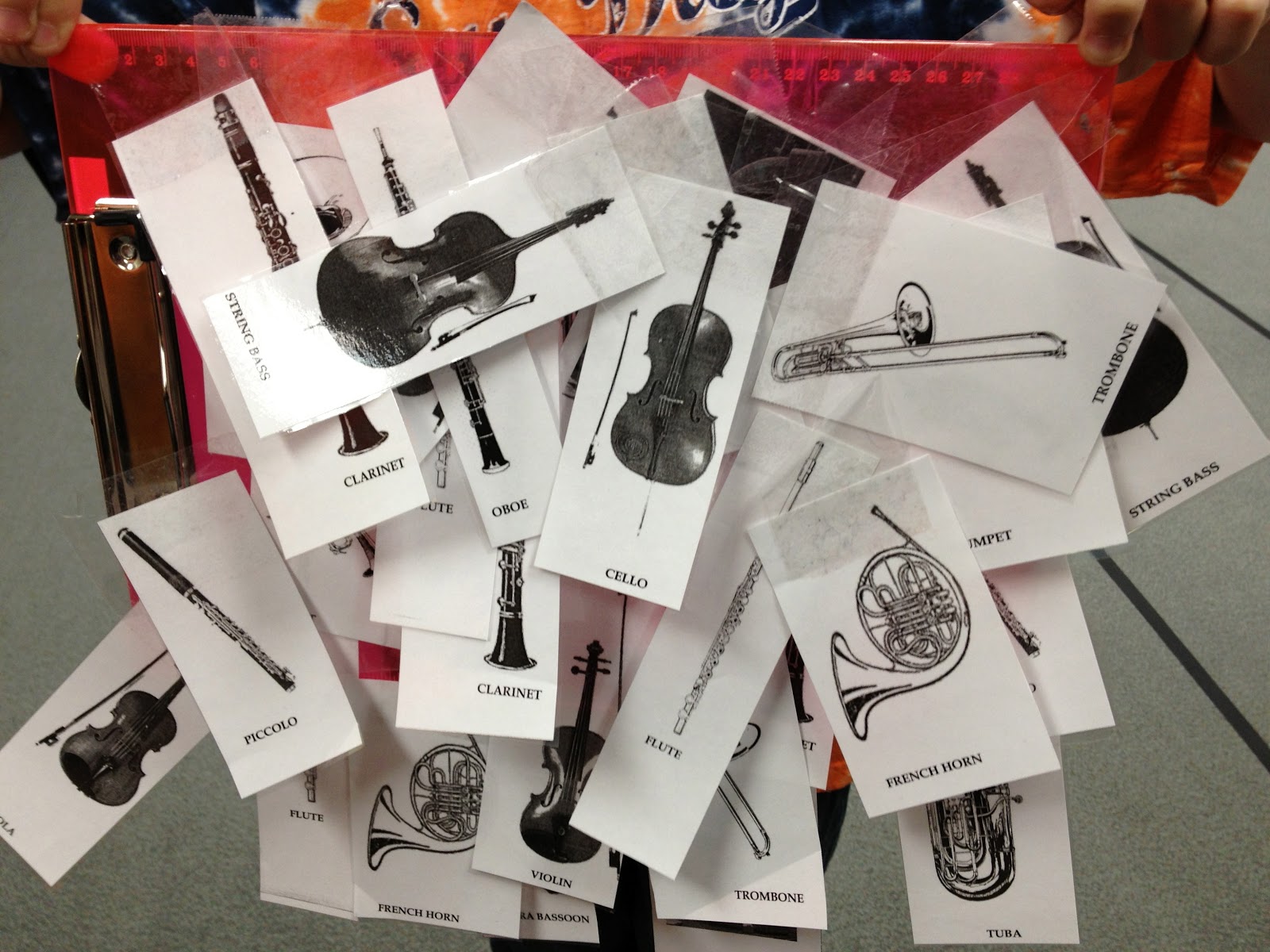
  Laminated pictures of single orchestral instruments (the size of an index card.)

Mine look like this:

Procedure: 
  • Begin by taping a laminated picture of an orchestra instrument on each student’s back. (Everyone but the student will be able to see their instrument.)
  • Lead class in brief discussion of what effective “yes” or “no” questions students could ask one another to discover what instrument is attached to their back.


Some question ideas:
“Am I in the woodwind family?”
“Do you use a reed to play my instrument?”
“Do you often play my instrument with a bow?”


  • Establish game rules. Students may roam around the roam asking one another only “yes” or “no” questions to discover which each instrument they have on their back. Students must go to the teacher to verify which instrument they are.
  • If a student guesses incorrectly, I give them an additional instrument to figure out. (This motivates them to ask good questions.)
This is an easy game to set up and the students ask to play again immediately.

Thursday, September 20, 2012

Tika Tika Tic Tac Toe


It's Tika Tika time 
(4 beamed 16th notes) 
in 3rd grade and we are busy practicing, chanting, singing and playing this fun rhythm!

While it's always an aim of mine to present tika tika in 2nd grade, I usually only have time to prepare this rhythm at the end of the 2nd grade year. Tika tika in early 3rd grade is what I usually do and it works well. 


Tika Tika Tic Tac Toe is one of those simple games that I always think the students will scoff at and then they love playing it and request it often. 
(I think it has to do with competition and the opportunity to throw things.)


All you need are nine cards of 4 beat rhythms featuring tika tika, bean bags, and some floor space. My rhythms are extracted from the tika tika songs the 3rd graders have been learning since school began. 

I set out the nine rhythm cards in a tic tac toe board formation on the floor. Students are separated into two teams and sit on the bar lines of the floor staff. (I have very large staff on my floor which functions as a seating arrangement when we're not in a circle. My floor staff is made with black velcro, ordered from a PE catalog.) The teams are designated the "red" team or the "blue" team, (those are our school colors.) A student stands below line E of the floor staff and chooses which rhythm card he is going to attempt. He chants the rhythm and the rest of the class repeats the rhythm. If he articulates the rhythm correctly, he can toss his team's color beanbag to claim that space. If the beanbag is touching the chosen card once it's landed, that team wins the space and their beanbag stays on the card. The opposing team then takes a turn.  The goal is for a team to get three spaces in a row.

This amazing simple game is a big hit with the students. There is individual and group practice of the new rhythm concept and we're working with rhythms from their song literature. I can think of several variations I could use to adjust the level of difficulty. To make it more challenging, the individual player must tap or clap the rhythm and his team has to identify which card was played. Another challenge could be the individual player must identify which song the rhythm is extracted from. (I would post the song titles on the board for students to refer to.) To make the game easier and more immediately successful, the teacher could chant the rhythm, the class echoes and then the individual player identifies which rhythm was played.


There are so many age-appropriate songs that incorporate tika tika.
Some of my students' favorite ti-ka t-ka songs:

  • Chicken on a Fencepost
  • In and Out Those Dusty Bluebells
  • Chanton Le Petit Moulin
  • Paw Paw Patch 
  • Tideo
  • Goodnight, Sleeptight


Sunday, September 9, 2012

Old House/Rhythm Review

I love the song Old House and I've been looking for something new to do with the song. It's a great la prep or practice song and I start by focusing on the call and response aspect of the song through use of a SMART Board presentation.

My SMART Board  lesson includes pages for students to fill in the boxes 
with just the melodic contour  shown with the words:
Additionally, there are pages for fill-in-the-box with the melodic patterns on the staff:


This year I developed a game to review rhythms with my older students. 
A few years ago,  some of our wonderful ROCKE members (now our ROCKE board!) presented a session at our state music ed conference in which they played Jenga while singing Joshua Fit the Battle of Jericho. I loved the idea of using the Jenga pieces so I adapted their game for this song.

Beat passing/rhythm review reading game:

Students sit in a circle. A small wooden tool box is filled with 4 beat rhythm cards.
During the song the toolbox is passed on the beat. 
(We sing the "build it up" verse first so we can build with the Jenga pieces.)
The student holding the box on the last beat of the song chooses a rhythm card from the toolbox and chants and claps the rhythm. The other students repeat the rhythm. 

If the student performs the rhythm correctly, he or she recieves Jenga pieces to build the house in the center of the circle. 

I often tie the number of Jenga pieces to the difficulty of the card. A card with 16th note patterns or a syncopated rhythm is worth 6 Jenga pieces while a rhythm card containing quarter notes and eighth note is worth 4 Jenga pieces.

Bonus Jenga pieces can be earned if the student can answer a question about the rhythm.
"How many beats is syn-co-pa?"
"What rhythm is in the 3rd beat?"
"How many sounds is ti ti-ka?"
"Can you speak that rhythm again but change 1 beat?"

The students love playing the game and it's been a fun way to review rhythms and get back into the habit of making music!


Wednesday, April 11, 2012

Body rhythms and chair beats

I've been engaged in a little "Spring cleaning and reorganizing" of my concept plans lately. The population of my school has changed in the past year and with it, I've noticed that my usual slew of activities need an update. While I've always include aural, visual and physical activities to engage all the learning styles of my students, I know I tend to rely heavily on aural and visual teaching.
With that in mind, I've recently revisited some rhythm activities for 1st grade.
Here's an activity I used many years ago, I believe I found it in a music textbook.

Body Rhythms and chair beats:

1. Place 4 chair at the front of the room. These are the beats.
(Option: on each chair, tape large construction paper hearts with 1  2  3  4 for each beat.)

2. On the white board or SMART Board write a 4 beat pattern using quarter notes, eighth notes, and rests,  preferably from a well-know song, (my 1st graders are preparing rest so I used "ta ti-ti ta (rest)" from "Pease Porridge Hot."

3. After the students have vocalized and tapped the rhythm, ask 4 students to write the rhythm with their bodies on the chair "beats."
1 student on 1 chair = ta, 2 students on 1 chair = ti-ti.
No student on a chair = Z (rest.)
My favorite thing about this activity is when the students see the empty chair and make that correlation: "there is no sound but the beat is still there. Our "piece of silence" is 1 beat."

Of course, you can have students compose their own rhythms on the "beat" chairs or use them for rhythmic dictation.

For a free SMART Board download of Quarter Rest (Z) Practice: Pease Porridge Hot and Naughty Kitty Cat, please visit my website


Friday, March 30, 2012

Songs with solos

Sing, sing, sing! I want my students to experience beautiful, in-tune singing and I am always on the lookout for songs with solos. I know students are more successful in pitch matching when they sing unaccompanied and have opportunities to sing alone. While I use several songs with solos in the primary grades, I don't use as many in the older grades.

Here is one that has been very successful with my older students. I often start with several knots tied in the rope so that a few students are singing the solo, (which cuts down on the initial fear factor for the singers.) I learned this song from my wonderful Level III teacher, Liz Arcaro.

Once a  student has sung a solo (or duet, or trio, depending on how many knots I tie in the rope,) they go to a barred instrument and accompany with a simple bourdon on C and G.

What are some of your favorite songs with solos?