Showing posts with label Manipulatives. Show all posts

Sunday, February 9, 2014

Freebie! Rhythm Cards: One Beat at a Time

Hello!

This has been a very challenging weekend for me and other teachers in my district as we experience decisions made by newly appointed members of our school board. I won't get political here. What I can do every day is work hard to teach children in my school the value, power and language of music.
Like the song says, "I've got rhythm, I've music, I've got my man, who could ask for anything more?" (Well, I could. But never mind. Just throw in a cup of strong coffee and I'll be good to go...)

So, rhythm. Let's make sure we've got that! 

One of my first "a-ha!" moments that came when I started my Kodály training was the importance of teaching the difference and the relationship between beat and rhythm. (Yes, that was something that was never stressed in my music education!) 
In my classroom when each new specific rhythm is taught I show heartbeats along with the rhythm so students can visualize how many sounds in a rhythm and where it falls on the beat. Often I show the rhythm right on top of the heartbeat.


In older grades, I transition to showing the rhythms underneath the beats.


Years ago I made student packs of rhythms on large foam hearts (and large "beat dots")


I use these with 1st graders as soon as we have a firm grasp of quarter notes and paired eighth notes. (On every heart or dot I drew a ta on one side and ti ti on the other.)
We use these for decoding song and chant rhythms, rhythmic dictation, and composing.

Inspired by all the great heart clip art that Teachers Pay Teachers members have been offering, I recently created rhythm cards showing one beat at a time. (Or two. The half note and eighth-quarter-eighth cards are 2 beats and twice as big as the one beat rhythms.)
The hearts are colorful and glittery, courtesy of Glitter Meets Glue Designs. (Some things  bring out the girly girl in me; I can't help being a sucker for glitter!)
Each rhythm comes with and without note heads. Click on the picture below to download these rhythm cards.


So, please, take my heart(s)! If you do download, I'd love your feedback. (I still consider myself a newbie in regards to making things for Teachers Pay Teachers and it's helpful to know what other music teachers find useful.)

Also, check out the Kodály Corner blog. I recently contributed my first post about opening songs. 

Have a great week and a sweet Valentine's Day!


Friday, September 13, 2013

sol mi Review and Star Foam

You know I have a fondness for foam shape manipulatives. At the start of the school year I found some foam star shapes priced at 10 for $1.00! (in the Target dollar bin section, of course)! I'm a big fan of creating manipulatives for matching games and stick to staff activities, but this time I thought I'd do something different and simple.

Since the beginning of the school year, my second graders have been reviewing singing and reading sol and mi on the staff. (Yes, I know they should have gotten to la by the end of 1st grade but it just doesn't happen like that in my world. The biggest obstacle is that I don't get to teach kindergarten; it is rare in my district for a school to provide art, music, and PE for kindergardeners. It's too bad; kindergarten is such a crucial time for them to have those classes but that's how it is for now.)

I incorporate solo singing often during class because students need to hear themselves and "fine tune" their listening in order to match pitch. Almost always, when someone has trouble matching pitch, the issue is their lack of focused listening skills. Children need several opportunities to sing solo. Solo singing through Chain singing is a fun way to quickly assess students.

On my foam stars I wrote out each phrase of the song Star Light several times:

After reviewing the song and game, the stars are scattered face down in a circle and each student choses their star. 

First I have students group themselves with their same phrase and we sing the song with each group singing their phrase. (This group practice sets them up for confident solo singing later; there's safety in numbers)!  Then they form a group of 4 by finding the other students with the phrases that completed their song. For fun, (and more practice), they all sing Star Light according to their phrase, but now they are standing in a mixed group and the others singing their phrase are standing farther away. (We're always building up that comfort level)!
Finally, each group "solos" and every student sings their phrase alone. We go around the room round robin style. When students are not singing they are body signing the melody.

My students are accustomed to singing solo; they sing the roll call at the beginning of every music class and we play many games that incorporate solos.  However, I always want to re-establish a non-threatening, supportive environment when our solo singing is not in the context of a game. (As the big sign at the front of my room states: "We will never laugh at anyone's honest effort!")

To go along with my sol mi review, I pulled out a scaffolded SMART Board file I created that I've used to practice sol and mi on a 1 line staff, then a 3 line staff, and a 5 line staff.
I fine-tuned it and put it up on Teachers Pay Teachers. 


A real 2nd grader covering lyrics with solfa buttons!

Oh my, I think I may have 6 products on TpT now. Crazy. What can I say? That's just how I roll these days... (Those things take me forever!)

I may not be prolific with TpT products but I do plan on updating this blog at least weekly.
Please check back with me if you're interested.
Have a lovely weekend!

Thursday, October 4, 2012

sol mi la Build a Song

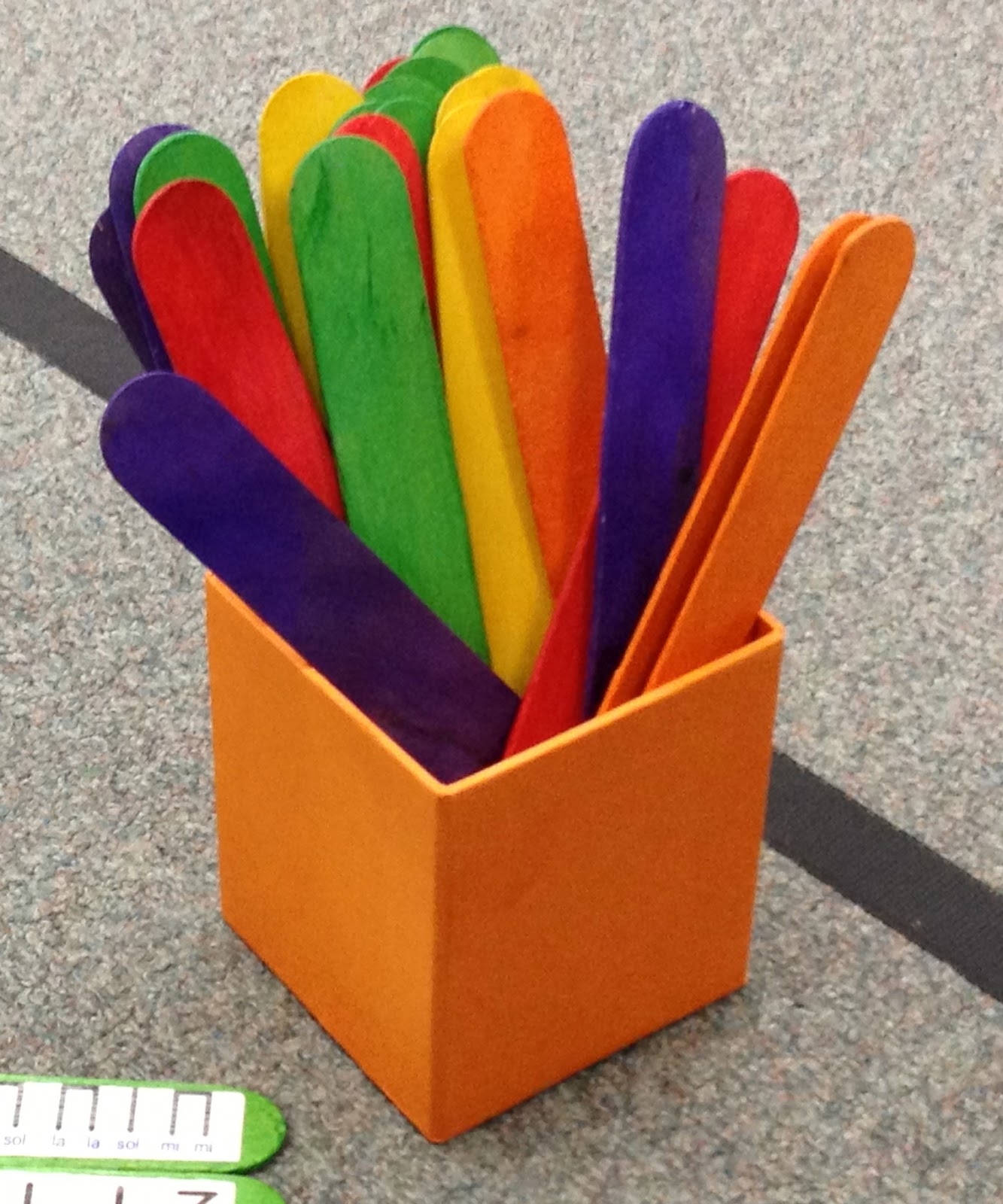
My husband is the art teacher and often has extra materials he can't use. (Many parents donate excess graph paper, card stock, and other supplies.) I spied several brightly colored tongue depressors in his room a few weeks ago. When I asked if he had plans for them, he said "no" and gladly handed them over. 
We've been preparing do and reviewing sol mi la songs in 2nd grade so I thought the sticks would provide a different way to practice constructing known songs. 

I used the following songs:
  • Ickle Ockle Blue Bottle
  • No Robbers Out Today
  • Lucy Locket
  • We Are Dancing in the Forest
I have a SMART Board file with each song written out in stick notation (with the solfa written in underneath the rhythm.) After printing out copies of each song I cut them up in 4 beat phrases and glued each phrase on one side of the stick. On the other side is a small picture indicating what song the phrase is from. (You can see the little pictures near the song titles.)


After reviewing the songs, we made a circle and students select one stick each. (One fun way to choose sticks is to play Apple Tree and have the eliminated student pick a stick until everyone has one.)

Students identify their "teammates" by finding those who have the same color and picture on their song stick. Each team rebuilds their assigned song as a team and practices singing and body signing the song. 

Once a team is confident their song is built correctly, they request a song sheet from me and check to see if it matches.

 2nd graders check their song

Are all of my students able to put together a known sol mi la song from memory 
with the stick notation? 
No way.

How can make this activity a successful learning experience for everyone?
Well...
  • Many students will benefit from being in a group where they can work together.
  • Some students with stronger skills have the option of building their song with a partner, (there are always uneven groups so this is a great way divvy out the song sticks.)
  • Some groups build their song with the song sheet in hand. Yes, they are essentially copying the song. This is still a reinforcement of the melody, rhythm and form of the song and those students can still be successful. 
I'm all about doing the same old thing in a slightly different way. 
(And I just love those colorful song sticks!)


Sunday, September 30, 2012

Doggie Doggie Beat/Rhythm/Melodic Direction Bones

I've been focused on making good quality manipulatives lately, which is a more tactful way of saying I'm a bit obsessed with manipulatives lately. (Can one be a "bit" obsessed? Maybe...)

I'm going to blame my friend Amy Abbott for this obsession/inspiration; she churns out more quality ideas and manipulatives in the span of a week then any teacher I know. (You probably already visit her wonderful blog, Music a la Abbott. If not, you should be checking in with her blog weekly. She posts often.)

I stopped by the teacher resource store Beyond the Blackboard this week looking for post-it notes in the shape of leaves. I did not find those, but I did find some stickers and paper bones.

Beyond the Blackboard and Teacher Created Resources are NOT paying me for advertising.
(hmm... maybe I should contact them...)
I do not enjoy making everything from scratch. While I greatly admire crafty people, I would rather spend less time putting things together. This means I sometimes spend more money. You could easily make your own bones and paw prints. 

I thought these could easily be made into a great beat/rhythm/melodic tracking manipulative for Doggie Doggie.  This is not a new idea, just a good one that I thought I could make into a classroom set of bones. The pack of bones contained 30, exactly what I use for a classroom set. (My largest 1st grade class is 29, which is ridiculous. PLEASE support your local schools by voting yes for any bond or mill levy in your area. That's a different post for another day but many districts are making huge cuts. I'll just say now that smaller class sizes make a huge difference in quality of instruction. ALL instruction.)

One side is for beat tracking while singing the song:
(Notice the strong beats are the same color as the bone outline. I also want to prepare 2/4 meter with these bones.)


The other side shows the rhythm and melodic direction of the song:


Here's a short video of my son singing and tracking:


I am looking forward to using these with a whole class. (All 29 of them!)


Friday, March 2, 2012


Manipulatives: Sol-fa Mittens
These sol-fa mittens are thin foam that were cut with a die cut press. 
Sol-fa names are written on both sides. I use these to practice echoing and decoding melodic patterns.
We start with the class echoing 4 beat pentatonic patterns sung with sol-fa while tapping their mittens.
Students must flip the mitten of the last pitch sung so that the thumb is facing the opposite direction, (creating a right hand mitten.) We progress to students echoing patterns sung on a neutral syllable, (like "loo.") 

I can easily see which students are decoding correctly as each student has a different color set of mittens. I also have a SMART Board page to help model for the class, (and the students love to come up to the board to flip the mittens.)