Showing posts with label 2nd grade. Show all posts

Monday, February 3, 2014

3 Books to Sing

Hello and welcome to February!

In my district we are getting into that time in the school year when the high-stakes testing starts. I am a parent of a 3rd grader this year and I have definitely noticed a change in his homework load. My job as a parent is to make sure my son continues to love reading, writing, math, and learning new things. Part of my job as the music teacher is to emphasize the fun and fulfillment that music gives us as individuals and as a society. I want my students to be musically literate but that won't happen unless they value music in their lives. So sometimes we sing for the sake of singing or enjoy listening for the sake of listening. Every musician was a music lover first.

So when the testing revs up in the year, I rev up the dancing, moving, and book sharing.
Children need a little extra nurturing during test season, some become quite stressed. 

The books I'm sharing today are books to sing to and with your students. When I sing and share a book I'm always amazed at how quiet and focused the children become. I pulled out three books last week that students always love.


Mama Don't Allow by Thacher Hurd

This is the tale of Miles Possum who gets a saxophone for his birthday, (from his Uncle Waylon, love that!) Miles forms a swamp band with other aspiring musicians and they soon  get their first gig; playing for the alligator ball! But when the music is done for the night and it's time for dinner, Miles and his friends discover what's on the menu- Swamp Band soup! The band finds a crafty way on saving themselves through music.

I share this book with my first graders. They love the word balloon retorts of the Swampville residents who would rather not hear the band practice. Read this book with lots of expression and different voices for each character. There is not a CD recording with this book so it's up to you to bring it to  life! Sing Mama Don't Allow with gusto and tapping feet and watch the kids swing and sway! When the band plays the Lullaby of Swampland, get creative and improvise a simply sung lullaby. I'm having as much fun as the kids when we read this in class. (My job today includes imitating different jazz instruments, singing and stomping this tune, and improvising a lullaby? SCORE!)

After we've read the book it's fun to pull out a recording of the song Mama Don't Allow. I play the version by The Rooftop Singers. It's a perfect "beat leader" song!


The Ants go Marching by Dan Crisp

Child's Play sure put out a lot of wonderful song books! 
This is one of my favorites. When the 1st and 2nd grades celebrate the 100th Day of School I pull out this book. Of course this is the old tune When Johnny Comes Marching Home Again with different lyrics. With each verse, ants are added in rows and columns, eventually adding up to 100. I'm always telling my students that music and math are BFFs. While this book does not show exactly what I mean, it's fun for them to see the math and ant visuals laid out in these pages. 
I sing this one to the students but I've never had a class who wasn't singing along by the 4th verse! (Don't forget those "boom, boom, boom!"s)

illustrated by Peter Spier

Here's an old ballad about a fox and his adventures as he hunts for food for his family. Peter Spier's artwork is beautiful. 

I initially sing this as we read it and then we listen to Pete Seeger or Jill Trinka version of the song. There are several renditions of this song, just look through iTunes. (I can amuse myself for hours poking around the internet listening to countless recordings of one song!)  My friend,(and fellow Kodály crusader in our district,) Steve Soich introduced me to Nickel Creek's recording of The Fox which is a huge hit with my students. Their version is a very rollicking bluegrass song that the first graders can't help but bounce to. 

That's (some) of what's going on in my music room. Have a musical week reading, singing, and moving!


Friday, September 13, 2013

sol mi Review and Star Foam

You know I have a fondness for foam shape manipulatives. At the start of the school year I found some foam star shapes priced at 10 for $1.00! (in the Target dollar bin section, of course)! I'm a big fan of creating manipulatives for matching games and stick to staff activities, but this time I thought I'd do something different and simple.

Since the beginning of the school year, my second graders have been reviewing singing and reading sol and mi on the staff. (Yes, I know they should have gotten to la by the end of 1st grade but it just doesn't happen like that in my world. The biggest obstacle is that I don't get to teach kindergarten; it is rare in my district for a school to provide art, music, and PE for kindergardeners. It's too bad; kindergarten is such a crucial time for them to have those classes but that's how it is for now.)

I incorporate solo singing often during class because students need to hear themselves and "fine tune" their listening in order to match pitch. Almost always, when someone has trouble matching pitch, the issue is their lack of focused listening skills. Children need several opportunities to sing solo. Solo singing through Chain singing is a fun way to quickly assess students.

On my foam stars I wrote out each phrase of the song Star Light several times:

After reviewing the song and game, the stars are scattered face down in a circle and each student choses their star. 

First I have students group themselves with their same phrase and we sing the song with each group singing their phrase. (This group practice sets them up for confident solo singing later; there's safety in numbers)!  Then they form a group of 4 by finding the other students with the phrases that completed their song. For fun, (and more practice), they all sing Star Light according to their phrase, but now they are standing in a mixed group and the others singing their phrase are standing farther away. (We're always building up that comfort level)!
Finally, each group "solos" and every student sings their phrase alone. We go around the room round robin style. When students are not singing they are body signing the melody.

My students are accustomed to singing solo; they sing the roll call at the beginning of every music class and we play many games that incorporate solos.  However, I always want to re-establish a non-threatening, supportive environment when our solo singing is not in the context of a game. (As the big sign at the front of my room states: "We will never laugh at anyone's honest effort!")

To go along with my sol mi review, I pulled out a scaffolded SMART Board file I created that I've used to practice sol and mi on a 1 line staff, then a 3 line staff, and a 5 line staff.
I fine-tuned it and put it up on Teachers Pay Teachers. 


A real 2nd grader covering lyrics with solfa buttons!

Oh my, I think I may have 6 products on TpT now. Crazy. What can I say? That's just how I roll these days... (Those things take me forever!)

I may not be prolific with TpT products but I do plan on updating this blog at least weekly.
Please check back with me if you're interested.
Have a lovely weekend!

Sunday, November 11, 2012

Turkey Turkey Gobbler: a favorite "re" song


Here is another one of my favorite Thanksgiving themed songs. 
It's perfect for my 2nd graders right now as we're preparing "re." 
This is a wonderful "re" song because the "res" are in a prominent place, 
(the 3rd beat,)  in the 1st and 3rd measures. The rhythm includes tas, ti-tis, and toos (half notes) in a simple to decipher form. This allows students to focus on the melody and not get hung up on a challenging rhythm. I am a proponent of many uses for one song but we are zoning in on hearing/singing/feeling that pitch between "mi" and "do" with this song.

Naturally, the song is enhanced by a great, active game and this one is a favorite of my students.

Before introducing the game, we hear and practice imitating the turkey gobble.
(Share real turkey sounds with your class by going here.)

By having a couple of minutes of "Turkey Gobble Choir Rehearsal" this is a good opportunity for students to practice watching a conductor for cut-offs, growing louder and growing softer, (and all with our head-voice gobbles! Hurray for more vocal exploration!) Once we've "got our gobble on," it's time for the game.

Game:
Standing circle, one farmer is chosen, one turkey is chosen.
The farmer is blindfolded. I have a turkey hat for the turkey to wear, (thank you again, Target dollar bin!)

Sing the song as class, then the farmer tries to find and tag the turkey by calling "Turkey!"
Turkey must respond with "Gobble! Gobble!" (high-pitched, head voice gobble.)

If farmer gets to close to the standing circle (the "fence") students simply call
out "fence" to prevent the farmer from running into them.

If the action goes on too long, I show a silent 10 second count down with my fingers. Both the farmer and the turkey choose new players. 


Happy late autumn!

P.S. Amy Abbott recently posted this song with a different game and reading activities. You can see her post here. (Great ideas from Amy!)

Saturday, November 10, 2012

Thanksgiving Day

Can you believe that Thanksgiving is just around the corner? 
Here is a Thanksgiving song I love to use in my classroom with 1st and 2nd graders.

Thanksgiving Day is a song I saw in the OAKE Western Division newsletter a number of years ago. It was submitted by Verla Boyd and Kathleen Bassett. (I've also seen a few variants of this song around the internet.)
We sing this with autoharp accompaniment. In the 1st grade classes students pair up and one student presses buttons for chord changes while the other strums the steady beat, (the autoharp sits on the floor and the strummer strums away from their body.) I bring this song back in 2nd grade for fun with one student per instrument, strumming and pressing buttons for chord changes.

This year I'm adding singing solos by having two students acting out the Turkey and Pumpkin roles.

You could easily add bordon accompaniment on Orff instruments if you want to avoid autoharps. 

I know that autoharps have fallen out of favor in most music classrooms and I understand why: many teachers inherit a few clunky, dusty autoharps that haven't been tuned since the 80s. However, autoharps can be a great addition to the music class allowing students to practice the steady beat and easily play full chord accompaniments. (It's exciting to hear the 3rd in the chord for a change!) 
It's worth remembering: for a song with 2 chord accompaniment you only have to tune the notes in those chords. That certainly saves time when you're faced with 6 out-of-tune autoharps!

If you are interested in a better autoharp, you must see Evo Bluestein's line of autoharps, especially the Sparrowharp. Evo came and presented a few sessions for the OAKE Western Division mini-conference in 2008 and he is a wonderful musician, teacher, and champion for traditional american folk music. His Evoharps have a beautiful sound and appearance and are so much easier to hold and play then the awkward Oscar Schmidt black and reddish autoharps in my room. I don't own a Evoharp yet, my school music budget is not that healthy and I'd rather buy it for myself and not have it belong to the school. Maybe I need to ask Santa!


Thursday, October 4, 2012

sol mi la Build a Song

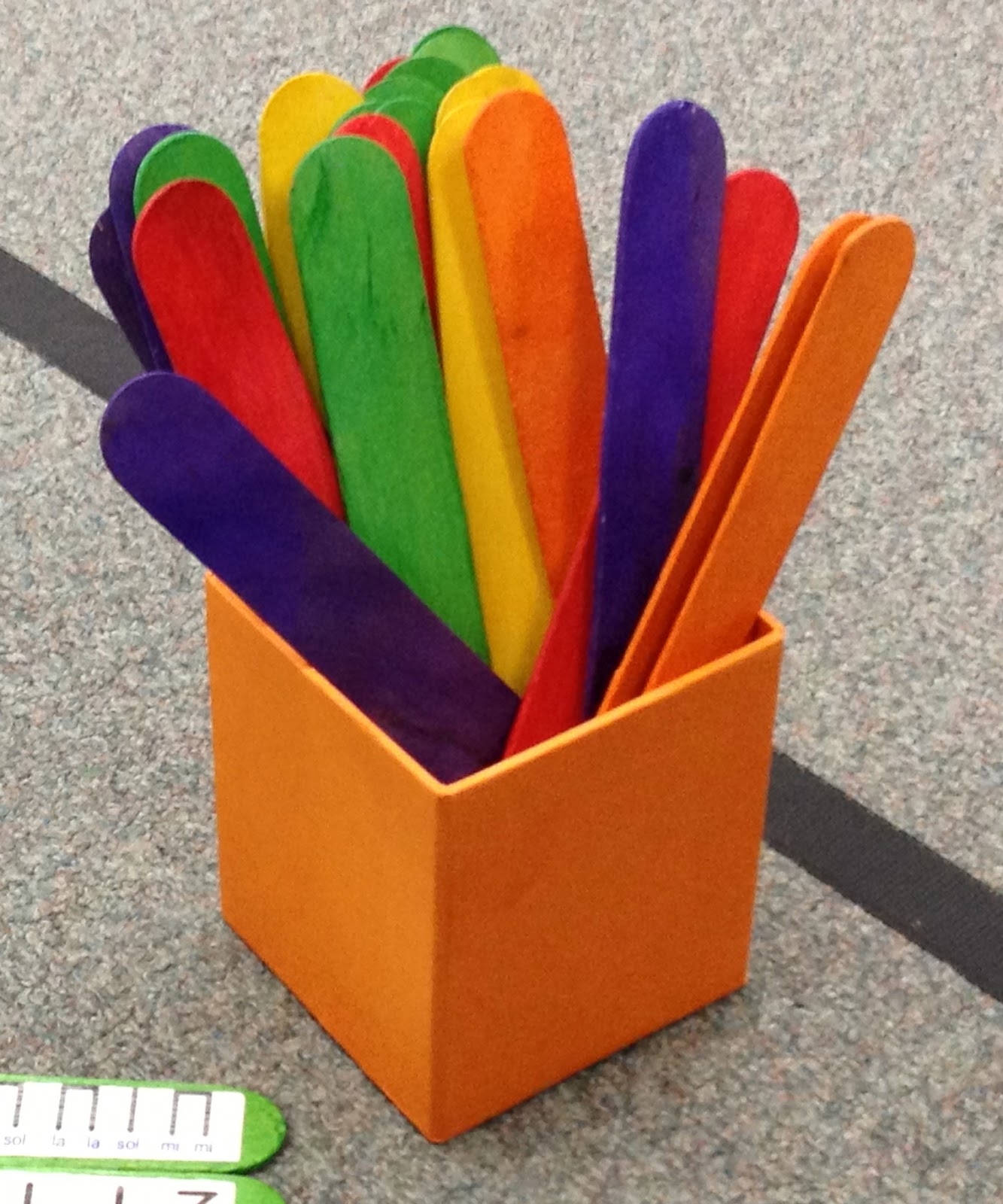
My husband is the art teacher and often has extra materials he can't use. (Many parents donate excess graph paper, card stock, and other supplies.) I spied several brightly colored tongue depressors in his room a few weeks ago. When I asked if he had plans for them, he said "no" and gladly handed them over. 
We've been preparing do and reviewing sol mi la songs in 2nd grade so I thought the sticks would provide a different way to practice constructing known songs. 

I used the following songs:
  • Ickle Ockle Blue Bottle
  • No Robbers Out Today
  • Lucy Locket
  • We Are Dancing in the Forest
I have a SMART Board file with each song written out in stick notation (with the solfa written in underneath the rhythm.) After printing out copies of each song I cut them up in 4 beat phrases and glued each phrase on one side of the stick. On the other side is a small picture indicating what song the phrase is from. (You can see the little pictures near the song titles.)


After reviewing the songs, we made a circle and students select one stick each. (One fun way to choose sticks is to play Apple Tree and have the eliminated student pick a stick until everyone has one.)

Students identify their "teammates" by finding those who have the same color and picture on their song stick. Each team rebuilds their assigned song as a team and practices singing and body signing the song. 

Once a team is confident their song is built correctly, they request a song sheet from me and check to see if it matches.

 2nd graders check their song

Are all of my students able to put together a known sol mi la song from memory 
with the stick notation? 
No way.

How can make this activity a successful learning experience for everyone?
Well...
  • Many students will benefit from being in a group where they can work together.
  • Some students with stronger skills have the option of building their song with a partner, (there are always uneven groups so this is a great way divvy out the song sticks.)
  • Some groups build their song with the song sheet in hand. Yes, they are essentially copying the song. This is still a reinforcement of the melody, rhythm and form of the song and those students can still be successful. 
I'm all about doing the same old thing in a slightly different way. 
(And I just love those colorful song sticks!)