Tuesday, January 22, 2013

COFFEE/Coffee Row


Happy New Year! (Is it too late in January to say that?)
Let's have some coffee!


COFFEE is one of my favorite 3/4 meter songs. It is a fun song to sing, students love it, and it has several uses in the music classroom.

This song pairs very nicely with Music Alone Shall Live.


Students sing COFFEE, then Music Alone Shall Live, and finally both songs simultaneously. (Ah, coffee and music, these are a few of my favorite things...)

About a million years ago at an Orff workshop in New Mexico I learned a chant that was written to accompany COFFEE. I apologize for not listing the source for Coffee Row, I still have the chant but I can not find the notes from that workshop. (If anyone out there can help shed light on where this might have come from, please let me know!)

This chant is from Jo Ella Hug from from Missoula, Montana. (Thank you, Signe!)
This chant partners very well COFFEE in an ABA form and/or as a partner song. This above image is from my SMART Board lesson; students drag red bar lines to show the correct measures for 3/4 meter. (Cue Ms. LeJeune: "What exactly are we measuring, students?" Students: "the BEAT!")

There are many ways you can arrange these songs and chants to create a enjoyable performance piece. In the past I've added barred instruments and dramatization.

*The SMART Board lesson featuring COFFEE and Coffee Row are exclusively available for purchase, (along with many other great digital lessons including a fun stick to staff matching game for COFFEE,) at the ROCKE Make and Take on Saturday, Jan. 26th, 2013 during CMEA at the Broadmoor in Colorado Springs. (Colorado's NAFME conference.)

Going to CMEA?
I am very excited to present a session: Electronic Engagement on Friday sponsored by ROCKE (Regional Organization of Colorado Kodály Educators.) 
My good friend, the lovely and talented Amy Abbott will also be presenting Manipulative Mania, also sponsored by ROCKE. (Do you follow Amy's extremely useful, very prolific blog? Of course you do.) 

I will also share a session on Friday at 3:00pm titled SMART Board Assessments in the Music Class Room. I hope to see many Colorado music teachers there!

Saturday, December 15, 2012

March from The Nutcracker and 1 beat rhythms: a practice in form (and foam!)

"O Christmas foam, O Christmas foam, how many are your uses!"

So Target has many Christmas foam packages in the dollar bin this year and I've been enjoying using them in a couple of different ways. (Reminder to self: look into purchasing stock in Target.)

We have been listening to selections of the Nutcracker and the March is a favorite of mine and the students'. It is instantly recognizable to most of the kids and they love moving to this piece.

I'm sure many music teachers are familiar with the body percussion movement that follows the rhythm for the March. I apologize for not sighting my source on this movement activity. I learned it about a million years ago, (well, the late 80s, which seems like a million years ago.) I am reasonably certain it was taught at an Orff workshop I attended while teaching in New Mexico. That's as much as I can narrow it down.

Movement activity for the March from The Nutcracker Suite:

Formation: standing circle

In the A and B sections the movements match the melodic rhythm of the piece.
The C section movements are to the beat.

ABACABA

A section:
stomp, pat-pat-pat   pat  pat  clap clap  snap
stomp, pat-pat-pat   pat  pat  clap clap  snap 
thumb dance for 16 beats
stomp, pat-pat-pat   pat  pat  clap clap  snap
thumb dance for 16 beats

B section:
(similar to A but traveling down the body)
snap, clap-clap-clap  clap clap  pat pat  stomp
thumb dance for  8 beats
snap, clap-clap-clap  clap clap  pat pat  stomp
thumb dance for  8 beats

C section:
"Russian Dance" (fold arms in front, squat and kick out heels)
32 beats

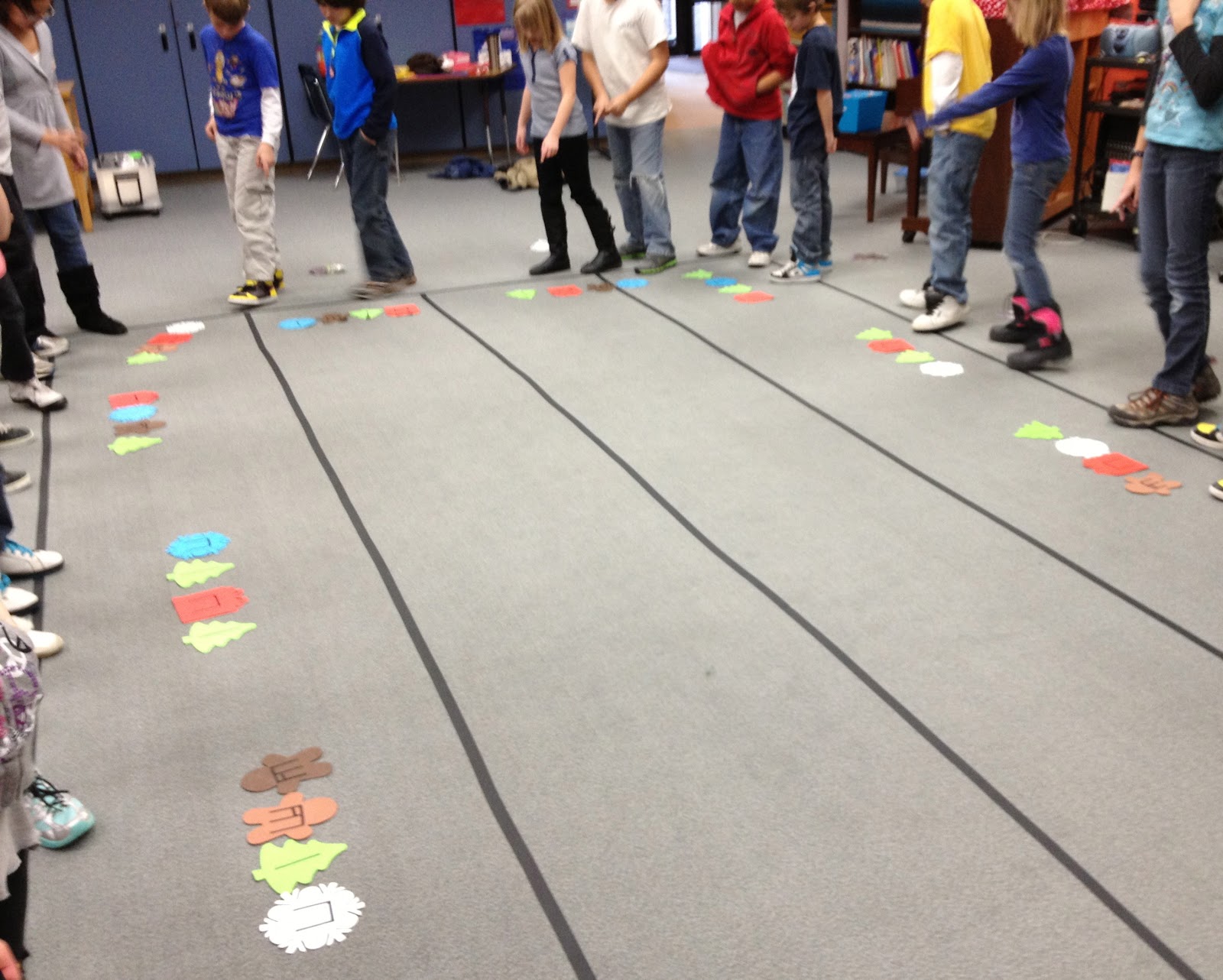
After learning and performing the movement I set out the foam shapes I have labeled with As Bs and Cs. I place the green pile of As, the red Bs and the white snowflake Cs near different walls of the music room. Students may work in pairs or on their own as they collect the section labels and map out the form. Initially I don't play the piece for them as they are collecting the foam labels and working it out. This is an excellent opportunity for students to practice their inner-hearing as they try to work out what order the form is in. I play the piece again as they check their answers. This is a fairly easy piece for them to work out and they enjoy seeing the symmetry of the March.


A completed form


These boys stacked their sections and flipped through them as they listened.

1 Beat Rhythms
My other use for all the foam I've bought is simple rhythmic dictation. 
The 4th graders are in heavy ti tika and tika ti practice and I made this set specifically for them. I know, I know, they should be "syn-co-pa-ing" by now but this group is just not ready at this time. Please don't call the Kodály police, sol-mi....sol-mi....sol-mi.... (whoops, that's their siren!)

Anyway, I wanted to make sure they could either chant the rhythm of each foam or the object name which matches the syllables with the rhythm.

pre-sent = ti ti
tree = ta
gin-ger bread = tika ti
snow = ta
snow-flake = ti ti 
(I actually cheated with snow and snow-flake. I wanted more tas in each set so I drew ti ti on one side of the snowflake and call it "snow-flake" and ta on the other side and call it "snow"! 
I could have also gone with "pre-sent" and "gift")

Each student had a rhythm pack and they decoded four beat patterns.
My basic procedure for rhythmic dictation is I play, (clap or play on a woodblock), they echo, and then they write/decode. Then I play the pattern again and they echo it only in their head and check/refine their answer.
With this rhythmic set I let the students chant the rhythm using either rhythm syllables or object names.


Pre-sent, gin-ger bread, snow,gin-ger bread
or
ti ti, tika ti, ta, tika ti

Students create their own patterns


Are you wondering, "where is ti tika?" Ah well, we just turned a gingerbread on his head! That was a fun discovery when I played a pattern including ti tika and the students had to figure out how to notate it with what they had. 
Of course, we had to talk about how unnatural it is to say GIN-ger bread, but they adapted immediately.

During another class period students composed their own 4 beat patterns and they walked around the room chanting each pattern accompanied by Leroy Anderson's Sleigh Ride. (If you try this and play that version of Sleigh Ride I highly recommend throwing it in Garage Band, Audacity or the Amazing Slow Downer and slowing down the tempo!)


I learned the hard way with Leroy Anderson's Sleigh Ride!


Have a very happy holiday! (Or holidays, if I am unable to write again before January. I am exhausted.)


Sunday, December 2, 2012

Dance of the Sugar Plum Fairy Play-a-long

'Tis the season to bring in the winter holiday music in music class!

I love introducing young students to the wonderful music of Tchaikovsky's Nutcracker Suite. The individual pieces are short and familiar to many kids. Several of the pieces provide an excellent opportunity to reinforce concepts we have been focused on in the music room.
Dance of the Sugar Plum Fairy is a favorite of many students. 


This short, festive piece is not only a chance for students to play-a-long with the celesta theme, it is also an excellent review of ABA form. (I ask students to improvise a "glittering snowflake dance" with their hands during the B section. Each sforzando could be a sudden gust of wintery wind.)

Additionally, I use it as a reading piece showing "split tis" or single eighth notes.  (A blogpost regarding split tis will be coming soon! Watch this space for ideas regarding teaching split tis after ti-ti is learned. )


Students will be intrigued by that rarely heard, fairy-like, bell-sounding instrument, the celesta. Here is video of someone playing this piece.
(This is the most close-up shot of someone playing the celesta that I could find.)

Every year I ask students if they have seen the Nutcracker ballet live and as the years go on, less and less students have had that experience. I can give them a glimpse of the ballet that they may never see live. (Don't you just love teaching with modern technology?)

Here a youtube video of the Dance of the Sugar Plum Fairy.

Download a free PDF file of  my play-a-long pages here.

Sunday, November 11, 2012

Turkey Turkey Gobbler: a favorite "re" song


Here is another one of my favorite Thanksgiving themed songs. 
It's perfect for my 2nd graders right now as we're preparing "re." 
This is a wonderful "re" song because the "res" are in a prominent place, 
(the 3rd beat,)  in the 1st and 3rd measures. The rhythm includes tas, ti-tis, and toos (half notes) in a simple to decipher form. This allows students to focus on the melody and not get hung up on a challenging rhythm. I am a proponent of many uses for one song but we are zoning in on hearing/singing/feeling that pitch between "mi" and "do" with this song.

Naturally, the song is enhanced by a great, active game and this one is a favorite of my students.

Before introducing the game, we hear and practice imitating the turkey gobble.
(Share real turkey sounds with your class by going here.)

By having a couple of minutes of "Turkey Gobble Choir Rehearsal" this is a good opportunity for students to practice watching a conductor for cut-offs, growing louder and growing softer, (and all with our head-voice gobbles! Hurray for more vocal exploration!) Once we've "got our gobble on," it's time for the game.

Game:
Standing circle, one farmer is chosen, one turkey is chosen.
The farmer is blindfolded. I have a turkey hat for the turkey to wear, (thank you again, Target dollar bin!)

Sing the song as class, then the farmer tries to find and tag the turkey by calling "Turkey!"
Turkey must respond with "Gobble! Gobble!" (high-pitched, head voice gobble.)

If farmer gets to close to the standing circle (the "fence") students simply call
out "fence" to prevent the farmer from running into them.

If the action goes on too long, I show a silent 10 second count down with my fingers. Both the farmer and the turkey choose new players. 


Happy late autumn!

P.S. Amy Abbott recently posted this song with a different game and reading activities. You can see her post here. (Great ideas from Amy!)

Saturday, November 10, 2012

Thanksgiving Day

Can you believe that Thanksgiving is just around the corner? 
Here is a Thanksgiving song I love to use in my classroom with 1st and 2nd graders.

Thanksgiving Day is a song I saw in the OAKE Western Division newsletter a number of years ago. It was submitted by Verla Boyd and Kathleen Bassett. (I've also seen a few variants of this song around the internet.)
We sing this with autoharp accompaniment. In the 1st grade classes students pair up and one student presses buttons for chord changes while the other strums the steady beat, (the autoharp sits on the floor and the strummer strums away from their body.) I bring this song back in 2nd grade for fun with one student per instrument, strumming and pressing buttons for chord changes.

This year I'm adding singing solos by having two students acting out the Turkey and Pumpkin roles.

You could easily add bordon accompaniment on Orff instruments if you want to avoid autoharps. 

I know that autoharps have fallen out of favor in most music classrooms and I understand why: many teachers inherit a few clunky, dusty autoharps that haven't been tuned since the 80s. However, autoharps can be a great addition to the music class allowing students to practice the steady beat and easily play full chord accompaniments. (It's exciting to hear the 3rd in the chord for a change!) 
It's worth remembering: for a song with 2 chord accompaniment you only have to tune the notes in those chords. That certainly saves time when you're faced with 6 out-of-tune autoharps!

If you are interested in a better autoharp, you must see Evo Bluestein's line of autoharps, especially the Sparrowharp. Evo came and presented a few sessions for the OAKE Western Division mini-conference in 2008 and he is a wonderful musician, teacher, and champion for traditional american folk music. His Evoharps have a beautiful sound and appearance and are so much easier to hold and play then the awkward Oscar Schmidt black and reddish autoharps in my room. I don't own a Evoharp yet, my school music budget is not that healthy and I'd rather buy it for myself and not have it belong to the school. Maybe I need to ask Santa!


Sunday, October 21, 2012

Apple and Pumpkin Melody Match

double-sided tone ladders for Apple Tree and Little Leaves

The second graders are currently in the land of "do."  
We've sung and played games, body signed, showed the "low" note by bending or ducking as we sang, echoed patterns while using individual tone ladders, and written do melodies with leaf note heads.


staff boards and leaf notes for melodic writing

This week I'll present do and the do clef and we'll focus on identifying, reading and writing do songs on the staff.

do Songs

  • Apple Tree
  • Little Leaves
  • Mouse Mousie
  • Pumpkin Man (only the first two measures)
  • One, Two, Three (Johnny Caught a Flea)


One of the practice activities I'll be incorporating is my 
Apple and Pumpkin Melody Match


I found foam apples (the come in packages mixed green and red and can be found in the dollar bin,) and foam pumpkins. (I really need to own stock in Target stores. They receive a lot of my cash.)

On each apple I wrote the solfa of a do melodic pattern. 
On the pumpkins I wrote the same melody on the staff with a do clef:


I stripped away the rhythm of these patterns because I want students to focus on the melody. (Have you ever noticed when showing mystery songs many kids will figure it out by matching the words and the rhythm and neglect the melody entirely? No? Just me? ...ok...) 

Each student will start the game with a pumpkin or an apple. 
They must find their partner and then write out their melody jointly on a staff board.   
I have pumpkin, ghost, leaves, and blackcat noteheads, (thank you, Amy!) once the pair have found each other they can choose which noteheads they use to write their pattern.

Here are some of the do patterns I've used and what song and phrase they are from:


Do you have additional do songs/activities? Please let me know.
Have a lovely autumn week!


Thursday, October 11, 2012

Instruments of the Orchestra Part 2

"Who Am I?" Instrument ID Game
I recently shared a few of my favorite resources for teaching instruments of the orchestra. Here is a instrument ID game that has been a huge hit with my students.


Materials:

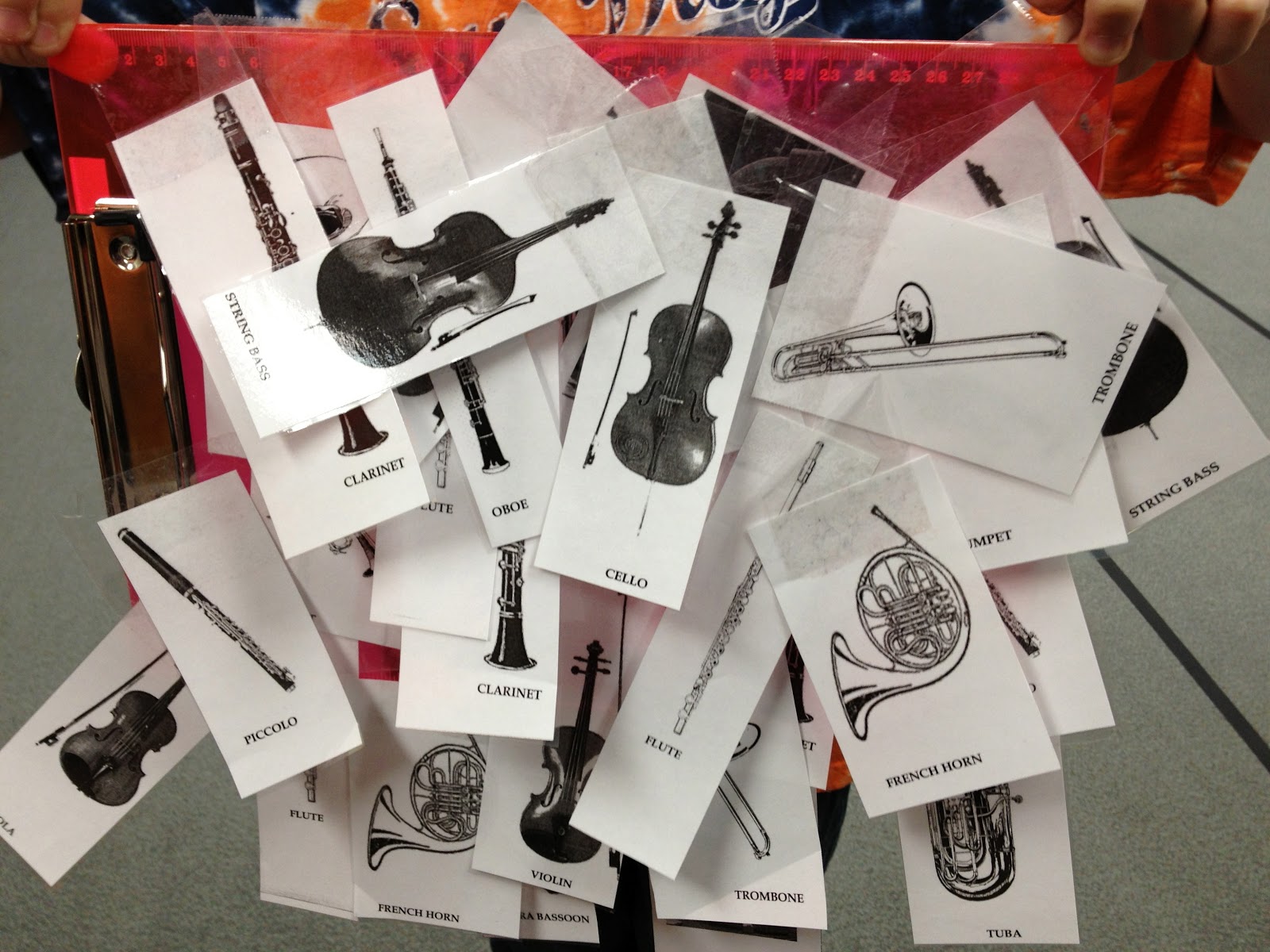
  Laminated pictures of single orchestral instruments (the size of an index card.)

Mine look like this:

Procedure: 
  • Begin by taping a laminated picture of an orchestra instrument on each student’s back. (Everyone but the student will be able to see their instrument.)
  • Lead class in brief discussion of what effective “yes” or “no” questions students could ask one another to discover what instrument is attached to their back.


Some question ideas:
“Am I in the woodwind family?”
“Do you use a reed to play my instrument?”
“Do you often play my instrument with a bow?”


  • Establish game rules. Students may roam around the roam asking one another only “yes” or “no” questions to discover which each instrument they have on their back. Students must go to the teacher to verify which instrument they are.
  • If a student guesses incorrectly, I give them an additional instrument to figure out. (This motivates them to ask good questions.)
This is an easy game to set up and the students ask to play again immediately.