Showing posts with label Rhythm. Show all posts

Sunday, February 9, 2014

Freebie! Rhythm Cards: One Beat at a Time

Hello!

This has been a very challenging weekend for me and other teachers in my district as we experience decisions made by newly appointed members of our school board. I won't get political here. What I can do every day is work hard to teach children in my school the value, power and language of music.
Like the song says, "I've got rhythm, I've music, I've got my man, who could ask for anything more?" (Well, I could. But never mind. Just throw in a cup of strong coffee and I'll be good to go...)

So, rhythm. Let's make sure we've got that! 

One of my first "a-ha!" moments that came when I started my Kodály training was the importance of teaching the difference and the relationship between beat and rhythm. (Yes, that was something that was never stressed in my music education!) 
In my classroom when each new specific rhythm is taught I show heartbeats along with the rhythm so students can visualize how many sounds in a rhythm and where it falls on the beat. Often I show the rhythm right on top of the heartbeat.


In older grades, I transition to showing the rhythms underneath the beats.


Years ago I made student packs of rhythms on large foam hearts (and large "beat dots")


I use these with 1st graders as soon as we have a firm grasp of quarter notes and paired eighth notes. (On every heart or dot I drew a ta on one side and ti ti on the other.)
We use these for decoding song and chant rhythms, rhythmic dictation, and composing.

Inspired by all the great heart clip art that Teachers Pay Teachers members have been offering, I recently created rhythm cards showing one beat at a time. (Or two. The half note and eighth-quarter-eighth cards are 2 beats and twice as big as the one beat rhythms.)
The hearts are colorful and glittery, courtesy of Glitter Meets Glue Designs. (Some things  bring out the girly girl in me; I can't help being a sucker for glitter!)
Each rhythm comes with and without note heads. Click on the picture below to download these rhythm cards.


So, please, take my heart(s)! If you do download, I'd love your feedback. (I still consider myself a newbie in regards to making things for Teachers Pay Teachers and it's helpful to know what other music teachers find useful.)

Also, check out the Kodály Corner blog. I recently contributed my first post about opening songs. 

Have a great week and a sweet Valentine's Day!


Saturday, November 30, 2013

Winter Rhythms- Half Note Practice

Hello!

Well, It's beginning to look a lot like Christmas around here! I have been enjoying the week off with my family, I hope you have had a great Thanksgiving holiday.

I have been teaching for many years and it's amazing to see what we can do with technology these days. Honestly, the first school I taught at had just a couple of computers in the library for student use, I would handwrite my lesson plans in a spiral notebook, (color coded by grade-level,) and I created rhythm, melody, and lyric reading pages on butcher paper. Now I have SMARTBoard files, PowerPoints, Sibelius notated songs, and iMovies I can use with my students. We've come a long way, baby!

I recently created a PDF slideshow for my second graders to practice reading half note rhythms. At my school, most students celebrate Christmas but some don't. I wanted to use some of the great winter clip art I've found to create a rhythm reading activity that is winter themed and not Christmas centric. I also like that I'll be able to continue to use it in the winter months following Christmas!

I have a small Teachers Pay Teachers store and my Rhythm Reading Half Note Winter Theme is featured there. (This is when I usually apologize/explain my small inventory of products on TpT, but I'm going to skip that today...) 

What I really like about these slides is that each half note rhythm is shown as 2 tied tas (quarter notes) and as a a half note. My 2nd graders are not at the present stage yet (where we show the rhythm and call it a half note,) so for now, they'll read the red slides, saying "long" for each 2 tied tas group.

They will read and vocalize this rhythm: "long ti ti ta"


Later, they will read the blue slides and vocalize this rhythm: "too ti ti ta" (I know other teachers use "taaaah" for half note which makes a lot of sense if you've prepped students with 2 tied tas. I have found great success in using "too". After presenting the half note, students can identify it as a different rhythm when you give it a unique name. Bonus: "Kids, how many beats is too worth?" "TWO!"


After I made the slides, I couldn't resist making it into a memory matching game. 
(I love memory matching games! They are great for centers.)
Students can match the 2 tied tas rhythms to the half note rhythms. 

("2 tied tas" is tedious to say. Say it 3 times in a row quickly right now, I dare ya. Maybe I should turn it into a choral warm-up. Hmmmm.)


Everything in my TpT store will be discounted 10%!

Have a relaxing weekend!


Saturday, December 15, 2012

March from The Nutcracker and 1 beat rhythms: a practice in form (and foam!)

"O Christmas foam, O Christmas foam, how many are your uses!"

So Target has many Christmas foam packages in the dollar bin this year and I've been enjoying using them in a couple of different ways. (Reminder to self: look into purchasing stock in Target.)

We have been listening to selections of the Nutcracker and the March is a favorite of mine and the students'. It is instantly recognizable to most of the kids and they love moving to this piece.

I'm sure many music teachers are familiar with the body percussion movement that follows the rhythm for the March. I apologize for not sighting my source on this movement activity. I learned it about a million years ago, (well, the late 80s, which seems like a million years ago.) I am reasonably certain it was taught at an Orff workshop I attended while teaching in New Mexico. That's as much as I can narrow it down.

Movement activity for the March from The Nutcracker Suite:

Formation: standing circle

In the A and B sections the movements match the melodic rhythm of the piece.
The C section movements are to the beat.

ABACABA

A section:
stomp, pat-pat-pat   pat  pat  clap clap  snap
stomp, pat-pat-pat   pat  pat  clap clap  snap 
thumb dance for 16 beats
stomp, pat-pat-pat   pat  pat  clap clap  snap
thumb dance for 16 beats

B section:
(similar to A but traveling down the body)
snap, clap-clap-clap  clap clap  pat pat  stomp
thumb dance for  8 beats
snap, clap-clap-clap  clap clap  pat pat  stomp
thumb dance for  8 beats

C section:
"Russian Dance" (fold arms in front, squat and kick out heels)
32 beats

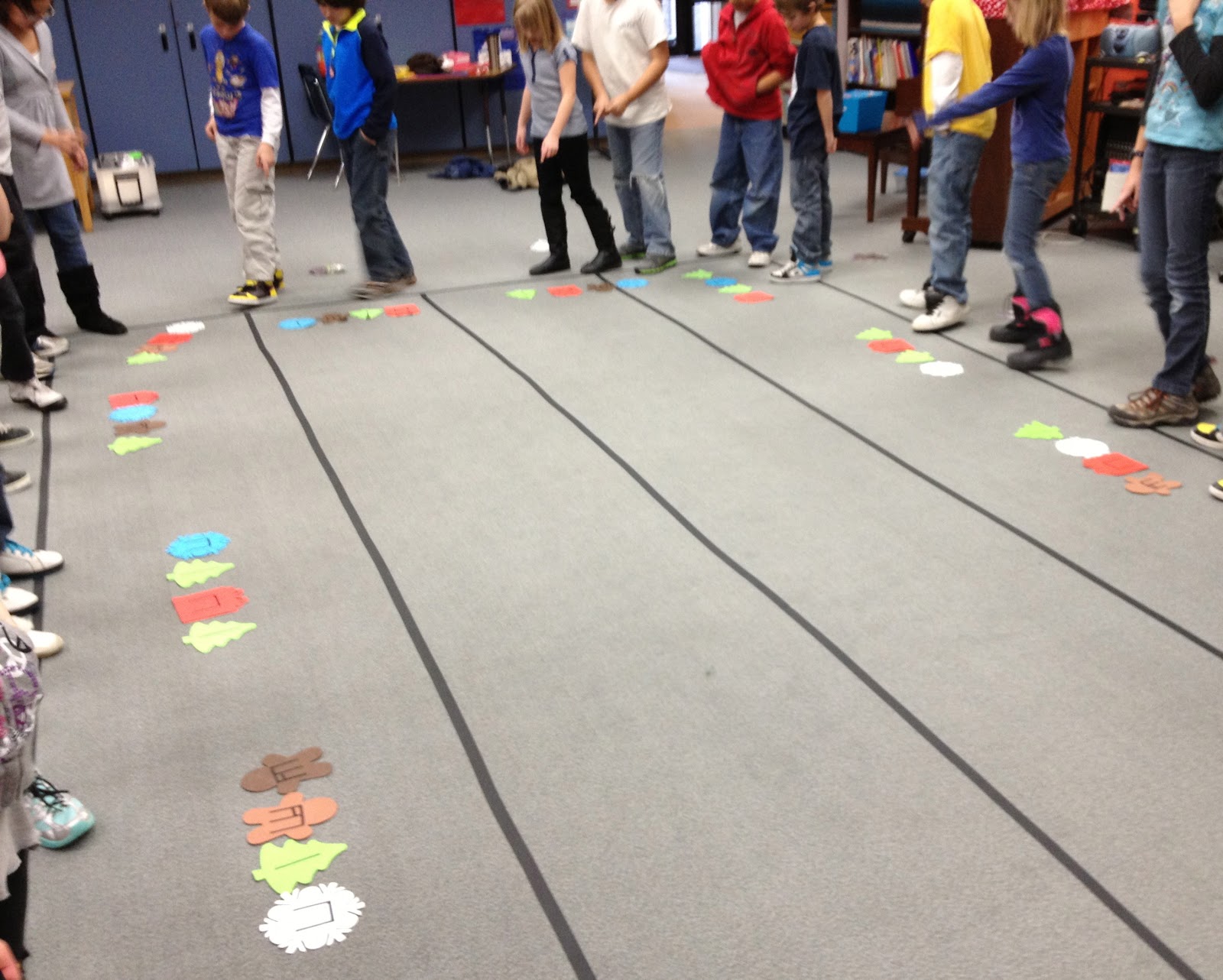
After learning and performing the movement I set out the foam shapes I have labeled with As Bs and Cs. I place the green pile of As, the red Bs and the white snowflake Cs near different walls of the music room. Students may work in pairs or on their own as they collect the section labels and map out the form. Initially I don't play the piece for them as they are collecting the foam labels and working it out. This is an excellent opportunity for students to practice their inner-hearing as they try to work out what order the form is in. I play the piece again as they check their answers. This is a fairly easy piece for them to work out and they enjoy seeing the symmetry of the March.


A completed form


These boys stacked their sections and flipped through them as they listened.

1 Beat Rhythms
My other use for all the foam I've bought is simple rhythmic dictation. 
The 4th graders are in heavy ti tika and tika ti practice and I made this set specifically for them. I know, I know, they should be "syn-co-pa-ing" by now but this group is just not ready at this time. Please don't call the Kodály police, sol-mi....sol-mi....sol-mi.... (whoops, that's their siren!)

Anyway, I wanted to make sure they could either chant the rhythm of each foam or the object name which matches the syllables with the rhythm.

pre-sent = ti ti
tree = ta
gin-ger bread = tika ti
snow = ta
snow-flake = ti ti 
(I actually cheated with snow and snow-flake. I wanted more tas in each set so I drew ti ti on one side of the snowflake and call it "snow-flake" and ta on the other side and call it "snow"! 
I could have also gone with "pre-sent" and "gift")

Each student had a rhythm pack and they decoded four beat patterns.
My basic procedure for rhythmic dictation is I play, (clap or play on a woodblock), they echo, and then they write/decode. Then I play the pattern again and they echo it only in their head and check/refine their answer.
With this rhythmic set I let the students chant the rhythm using either rhythm syllables or object names.


Pre-sent, gin-ger bread, snow,gin-ger bread
or
ti ti, tika ti, ta, tika ti

Students create their own patterns


Are you wondering, "where is ti tika?" Ah well, we just turned a gingerbread on his head! That was a fun discovery when I played a pattern including ti tika and the students had to figure out how to notate it with what they had. 
Of course, we had to talk about how unnatural it is to say GIN-ger bread, but they adapted immediately.

During another class period students composed their own 4 beat patterns and they walked around the room chanting each pattern accompanied by Leroy Anderson's Sleigh Ride. (If you try this and play that version of Sleigh Ride I highly recommend throwing it in Garage Band, Audacity or the Amazing Slow Downer and slowing down the tempo!)


I learned the hard way with Leroy Anderson's Sleigh Ride!


Have a very happy holiday! (Or holidays, if I am unable to write again before January. I am exhausted.)


Sunday, September 30, 2012

Doggie Doggie Beat/Rhythm/Melodic Direction Bones

I've been focused on making good quality manipulatives lately, which is a more tactful way of saying I'm a bit obsessed with manipulatives lately. (Can one be a "bit" obsessed? Maybe...)

I'm going to blame my friend Amy Abbott for this obsession/inspiration; she churns out more quality ideas and manipulatives in the span of a week then any teacher I know. (You probably already visit her wonderful blog, Music a la Abbott. If not, you should be checking in with her blog weekly. She posts often.)

I stopped by the teacher resource store Beyond the Blackboard this week looking for post-it notes in the shape of leaves. I did not find those, but I did find some stickers and paper bones.

Beyond the Blackboard and Teacher Created Resources are NOT paying me for advertising.
(hmm... maybe I should contact them...)
I do not enjoy making everything from scratch. While I greatly admire crafty people, I would rather spend less time putting things together. This means I sometimes spend more money. You could easily make your own bones and paw prints. 

I thought these could easily be made into a great beat/rhythm/melodic tracking manipulative for Doggie Doggie.  This is not a new idea, just a good one that I thought I could make into a classroom set of bones. The pack of bones contained 30, exactly what I use for a classroom set. (My largest 1st grade class is 29, which is ridiculous. PLEASE support your local schools by voting yes for any bond or mill levy in your area. That's a different post for another day but many districts are making huge cuts. I'll just say now that smaller class sizes make a huge difference in quality of instruction. ALL instruction.)

One side is for beat tracking while singing the song:
(Notice the strong beats are the same color as the bone outline. I also want to prepare 2/4 meter with these bones.)


The other side shows the rhythm and melodic direction of the song:


Here's a short video of my son singing and tracking:


I am looking forward to using these with a whole class. (All 29 of them!)


Thursday, September 20, 2012

Tika Tika Tic Tac Toe


It's Tika Tika time 
(4 beamed 16th notes) 
in 3rd grade and we are busy practicing, chanting, singing and playing this fun rhythm!

While it's always an aim of mine to present tika tika in 2nd grade, I usually only have time to prepare this rhythm at the end of the 2nd grade year. Tika tika in early 3rd grade is what I usually do and it works well. 


Tika Tika Tic Tac Toe is one of those simple games that I always think the students will scoff at and then they love playing it and request it often. 
(I think it has to do with competition and the opportunity to throw things.)


All you need are nine cards of 4 beat rhythms featuring tika tika, bean bags, and some floor space. My rhythms are extracted from the tika tika songs the 3rd graders have been learning since school began. 

I set out the nine rhythm cards in a tic tac toe board formation on the floor. Students are separated into two teams and sit on the bar lines of the floor staff. (I have very large staff on my floor which functions as a seating arrangement when we're not in a circle. My floor staff is made with black velcro, ordered from a PE catalog.) The teams are designated the "red" team or the "blue" team, (those are our school colors.) A student stands below line E of the floor staff and chooses which rhythm card he is going to attempt. He chants the rhythm and the rest of the class repeats the rhythm. If he articulates the rhythm correctly, he can toss his team's color beanbag to claim that space. If the beanbag is touching the chosen card once it's landed, that team wins the space and their beanbag stays on the card. The opposing team then takes a turn.  The goal is for a team to get three spaces in a row.

This amazing simple game is a big hit with the students. There is individual and group practice of the new rhythm concept and we're working with rhythms from their song literature. I can think of several variations I could use to adjust the level of difficulty. To make it more challenging, the individual player must tap or clap the rhythm and his team has to identify which card was played. Another challenge could be the individual player must identify which song the rhythm is extracted from. (I would post the song titles on the board for students to refer to.) To make the game easier and more immediately successful, the teacher could chant the rhythm, the class echoes and then the individual player identifies which rhythm was played.


There are so many age-appropriate songs that incorporate tika tika.
Some of my students' favorite ti-ka t-ka songs:

  • Chicken on a Fencepost
  • In and Out Those Dusty Bluebells
  • Chanton Le Petit Moulin
  • Paw Paw Patch 
  • Tideo
  • Goodnight, Sleeptight


Sunday, September 9, 2012

Old House/Rhythm Review

I love the song Old House and I've been looking for something new to do with the song. It's a great la prep or practice song and I start by focusing on the call and response aspect of the song through use of a SMART Board presentation.

My SMART Board  lesson includes pages for students to fill in the boxes 
with just the melodic contour  shown with the words:
Additionally, there are pages for fill-in-the-box with the melodic patterns on the staff:


This year I developed a game to review rhythms with my older students. 
A few years ago,  some of our wonderful ROCKE members (now our ROCKE board!) presented a session at our state music ed conference in which they played Jenga while singing Joshua Fit the Battle of Jericho. I loved the idea of using the Jenga pieces so I adapted their game for this song.

Beat passing/rhythm review reading game:

Students sit in a circle. A small wooden tool box is filled with 4 beat rhythm cards.
During the song the toolbox is passed on the beat. 
(We sing the "build it up" verse first so we can build with the Jenga pieces.)
The student holding the box on the last beat of the song chooses a rhythm card from the toolbox and chants and claps the rhythm. The other students repeat the rhythm. 

If the student performs the rhythm correctly, he or she recieves Jenga pieces to build the house in the center of the circle. 

I often tie the number of Jenga pieces to the difficulty of the card. A card with 16th note patterns or a syncopated rhythm is worth 6 Jenga pieces while a rhythm card containing quarter notes and eighth note is worth 4 Jenga pieces.

Bonus Jenga pieces can be earned if the student can answer a question about the rhythm.
"How many beats is syn-co-pa?"
"What rhythm is in the 3rd beat?"
"How many sounds is ti ti-ka?"
"Can you speak that rhythm again but change 1 beat?"

The students love playing the game and it's been a fun way to review rhythms and get back into the habit of making music!